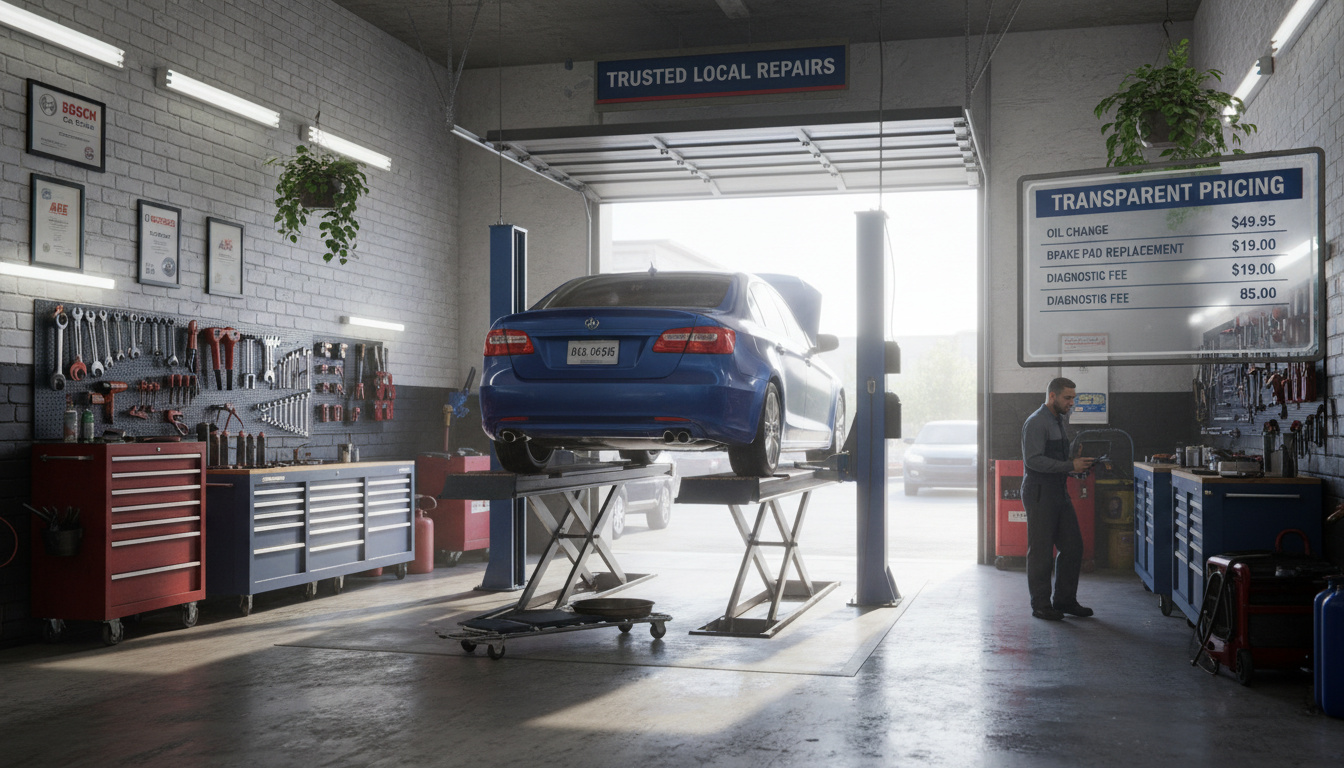
Searching for “my car near me” typically signals immediate need—whether a warning light flickered during your morning commute or grinding brakes demand attention before tomorrow’s highway drive. Americans now face an average expenditure of $838 per common repair according to Kelley Blue Book research, with annual maintenance and unexpected failures pushing total vehicle upkeep close to $900 yearly.
The disparity between states and shop types complicates quick decisions. Connecticut garages charge $281.53 per hour on average, while identical labor in Michigan costs roughly $211, per AAA state-by-state data. Understanding these variables prevents both overpayment and substandard repairs when proximity feels urgent.
Local search urgency has intensified as maintenance costs rose 2,479% since 1947, translating a $500 repair bill from 1947 to roughly $12,898 in 2026 terms.
How Do I Find Trustworthy Car Repair Near My Location Right Now?
Quick Local Search Tips
Enable location services and filter by “open now.” Cross-reference Google Business Profiles with Consumer Reports reliability data before calling.
Top Service Categories
Diagnostics, brake service, oil changes, transmission work, and EV battery health checks dominate localized queries.
Average Costs by Fix
Oil changes run $77–$117; brake jobs $221–$629; alternator replacement $450–$959.
Critical Red Flags
Unitemized bills, pressure for immediate upsells, and refusal to provide written estimates violate FTC guidelines.
- Labor rates swing from $100/hour in southern states to $281/hour in Connecticut.
- Honda owners average $583 in annual repairs; Land Rover drivers face $1,686.
- Independent shops typically charge $140/hour versus dealer parts markups of 40–60%.
- EV repairs command 20–30% labor premiums; Tesla Model Y averages $2,510 annually.
- Mobile services handle battery replacements ($237–$281) and tire plugs ($25–$60).
- New vehicles cost approximately $0.10/mile or $1,330/year to maintain at average mileage.
- The FTC mandates written estimates for any work exceeding $100.
| Service Type | Average Cost Range | Time Required | Urgency Level |
|---|---|---|---|
| Oil Change (oil + filter) | $77–$117 | 30–60 minutes | Scheduled |
| Brake Pad/Rotor Replacement | $221–$629 | 1–3 hours | High |
| Alternator Replacement | $450–$959 | 2–4 hours | Critical |
| Diagnostic/Multipoint Inspection | $50–$150 | 30–90 minutes | Immediate |
| Transmission Replacement | $3,000–$9,000+ | 1–3 days | Critical |
| EV Battery Replacement | $4,000–$18,000 | 4–8 hours | High |
What Drives the Price Tag for Auto Service in My Area?
Three primary variables dictate your final invoice: geographic labor rates, vehicle brand complexity, and whether the service constitutes an emergency.
Regional Labor Rate Disparities
National averages obscure extreme geographic variance. While independent shops average $140/hour nationally, West Coast facilities reach $190/hour, and southern states hover between $100–$125/hour. California specifically averages $271.10/hour according to AAA’s 2026 labor rate surveys.
Consider crossing state lines for major repairs if you live near jurisdictional borders. Ohio and Iowa average $211–$214/hour, potentially saving hundreds on multi-day transmission or engine work compared to neighboring high-cost states.
Vehicle Brand Impact on Budget
Ownership costs vary dramatically by manufacturer. Data compiled by Consumer Affairs shows Kia Soul owners pay approximately $659 annually, while Tesla Model Y drivers face $2,510 yearly maintenance bills. Traditional combustion engines generally cost less to service than electric vehicles, though Hyundai’s Kona Electric breaks the trend at $734 average annual repair costs.
Emergency Premium Pricing
After-hours calls, weekend service, and mobile dispatching inflate base rates. Emergency battery replacements cost $237–$281 when performed roadside versus potentially less at a scheduled shop visit. Pre-purchase inspections—costing roughly $100–$200—prevent emergency scenarios by identifying head gasket issues ($3,000–$5,500 to repair) or engine failures ($5,000–$10,000+) before purchase.
Which Certifications Prove a Mechanic Is Qualified?
Not all garages maintain equal technical standards. Verification requires looking beyond customer reviews to documented credentials and facility protocols.
Industry Standard Credentials
ASE (Automotive Service Excellence) certification represents the baseline for competent mechanical work. AAA-approved facilities undergo additional scrutiny and adhere to standardized labor rate reporting. Aftermarket industry analysis confirms that certified independent shops typically charge 40–60% less for parts than franchised dealerships while maintaining equivalent labor quality.
Warning Signs of Untrustworthy Operations
Consumer protection agencies identify specific behaviors indicating potential fraud or incompetence. Shops refusing second opinions, avoiding diagnostic transparency, or quoting oil changes above $150 without synthetic oil justification warrant immediate avoidance.
The FTC requires written estimates for repairs exceeding $100 and mandates notification before exceeding quoted prices by 10%. Shops requesting verbal authorization for “lifetime” guarantees without documentation violate federal consumer protection standards. Report suspected scams directly to ftc.gov.
Mobile Repair Services Versus Traditional Shops: Which Suits My Emergency?
The rise of mobile mechanic services has fragmented the traditional garage model, offering distinct advantages for specific scenarios while presenting limitations for complex repairs.
When Mobile Makes Sense
Battery failures, tire punctures, and minor electrical diagnostics suit mobile operations perfectly. AAA maintains the largest network for these services, handling everything from tire plugs ($25–$60) to alternator testing. Mobile technicians eliminate towing costs and minimize downtime for commuters stranded in office parking facilities.
The Fixed Garage Advantage
Transmission rebuilds, suspension overhauls, and EV battery replacements require hydraulic lifts and specialized tooling unavailable in van-based operations. Fixed facilities also offer warranty protection and parts storage that mobile providers cannot match. For repairs exceeding four hours or requiring component removal, traditional shops provide necessary infrastructure.
Mobile mechanics cannot perform alignments, transmission replacements, or extensive engine work requiring vehicle lifts. Reserve mobile services for battery swaps, basic diagnostics, and brake pad inspections to avoid redundant labor charges if the vehicle must eventually visit a fixed facility.
When Does My Vehicle Actually Need Routine Maintenance?
- Every 5,000–10,000 miles: Oil changes and tire rotations ($47–$68). Source: Insurify maintenance data.
- Every 15,000 miles: Cabin air filter replacement ($68–$104) and wiper blade installation ($49–$63).
- Every 30,000 miles: Brake fluid exchange, transmission filter inspection, and spark plug evaluation.
- Every 60,000 miles: Timing belt inspection, coolant system flush, and suspension component review.
- At 100,000+ miles: Water pump replacement, fuel system cleaning, and differential service.
What Repair Costs Are Predictable Versus Variable?
Established Pricing Factors
- AAA-approved shop labor rates by state
- OEM parts pricing versus aftermarket alternatives
- Routine maintenance intervals specified in owner manuals
- FTC disclosure requirements for estimates
Variable or Uncertain Elements
- Individual mechanic experience within certified shops
- Hidden structural damage discovered mid-repair
- Regional parts availability delays
- Fluctuating EV battery replacement timelines
Why Are Local Labor Rates So Different Across States?
Economic geographers cite commercial rent disparities, state licensing requirements, and regional specialization as primary drivers of the $70/hour+ gaps between markets. Connecticut and California’s elevated commercial real estate costs directly translate to hourly labor premiums, while Midwestern states benefit from lower overhead and higher competition density.
Parts scarcity has further complicated 2025 pricing. Supply chain constraints for EV-specific components and semiconductor-dependent diagnostic tools force shops to implement scarcity surcharges. Historical inflation data suggests these pressures will intensify as vehicle complexity increases.
Travelers seeking consistent service quality might reference our guide to Yamba Big 4 – Pet-Friendly Family Riverside Guide for planning extended road trips where maintenance needs may arise far from home.
What Do Consumer Protection Agencies Recommend?
Federal and nonprofit organizations maintain consistent guidance for automotive service consumers, emphasizing documentation and verification.
“Obtain written estimates before authorizing work. Shops must notify you before exceeding the estimate by 10% or more. Avoid verbal guarantees without written documentation.”
— Federal Trade Commission Consumer Advice
“Look for the ASE sign or AAA-approved facility designation. These indicate technicians have passed standardized testing and facilities meet equipment requirements.”
— AAA Automotive Services Division
What’s My First Step to Get My Car Fixed Locally?
Start by verifying your vehicle’s specific symptoms against maintenance schedules to determine urgency. Search certified facilities within a five-mile radius using AAA’s shop locator or Google Maps’ “open now” filters, then request written estimates from three providers. For those researching international automotive standards or planning overseas vehicle purchases, see our coverage of Where Is Doha – Qatar Capital on Persian Gulf Coast for context on global automotive markets.
Frequently Asked Questions
How much should a diagnostic test cost at a local shop?
Expect between $50 and $150 depending on your region and whether the shop holds ASE or luxury vehicle certifications.
Can I trust mobile mechanics for emergency repairs?
Yes, for batteries, tires, and diagnostics. Avoid mobile services for transmission, suspension, or EV battery work requiring lifts.
Why do dealers charge more than independent shops?
Dealerships typically markup parts 40–60% above cost and charge premium labor rates for brand-specific expertise.
How do I verify ASE certification?
Look for blue and white ASE plaques in shop windows or ask technicians to show their individual certification cards.
What constitutes an illegal repair practice?
Charging more than 10% above written estimates without notification, refusing itemized bills, or performing unauthorized work violate FTC rules.
Are EVs always more expensive to repair?
Not universally. While Tesla Model Y averages $2,510 annually, Hyundai Kona Electric repairs average only $734.
How often should I rotate tires?
Every 5,000–8,000 miles, typically coinciding with oil change intervals at a cost of $47–$68.

Ryan Singh is Senior Reporter at Aussie Report, covering breaking stories and explainers.