
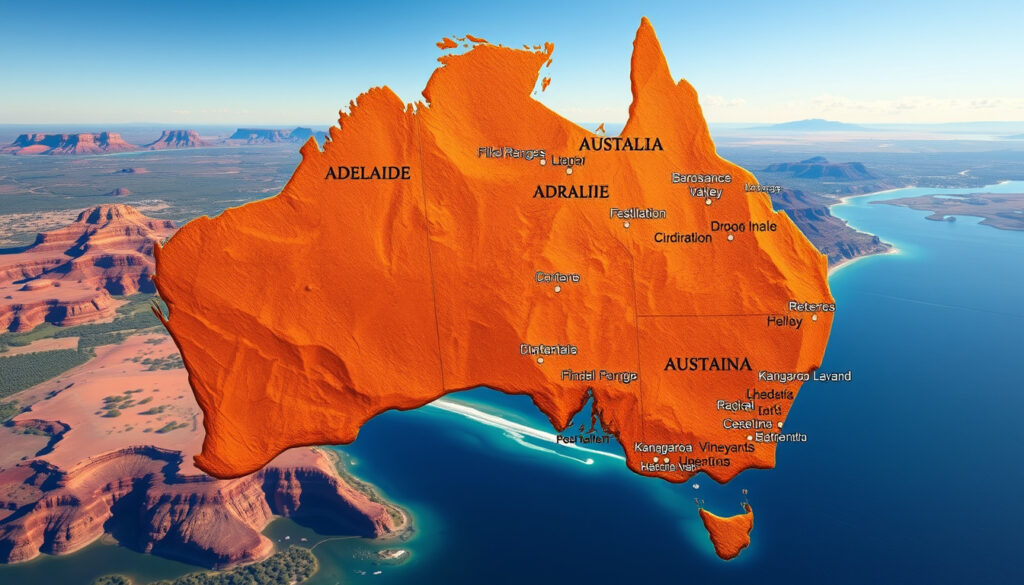
South Australia occupies a vast sweep of southern central Australia, spanning nearly one million square kilometres from the Mediterranean coastline around Adelaide to the edge of the outback interior. The state shares its borders with New South Wales, Victoria, and the Northern Territory, making it a crossroads between Australia’s eastern and western halves. Understanding the geography of South Australia requires access to reliable cartographic resources that capture everything from urban streets to remote unsealed roads.
The state’s landscape presents remarkable diversity, from the vineyard-covered hills of the Barossa to the ancient rock formations of the Flinders Ranges. Maps of South Australia serve multiple purposes for residents, researchers, and visitors alike. Road maps help navigate the Stuart Highway and coastal routes, while topographic charts reveal elevation changes and waterway systems across the interior. The availability of official digital resources from government agencies has made geographic planning more accessible than ever before.
This guide examines the practical resources available for working with South Australia maps, including downloadable PDFs, interactive tools, and topographic data suitable for both recreational and professional use.
Where is South Australia Located on a Map?
Southern central Australia, bordered by NSW, VIC, NT, and WA
Adelaide (population approximately 1.4 million)
983,482 square kilometres
Adelaide Hills, Flinders Ranges, Eyre Peninsula
Key Boundaries and Neighboring States
The geographical coordinates of South Australia extend from approximately 26°S to 38°S latitude and 129°E to 141°E longitude. This positioning places much of the state within the arid and semi-arid climatic zones, though the southern coastal areas enjoy Mediterranean conditions. The boundary with the Northern Territory, finalized in 1978 following the passage of the Northern Territory Acceptance Act, runs along the 26°S parallel from the Gulf of Carpentaria westward to the border with Western Australia.
The southern border with Victoria follows the Murray River for a significant portion, creating a natural boundary that has shaped agricultural settlement patterns. The northeastern corner meets New South Wales at Poeppel’s Corner, one of Australia’s most recognizable survey points where three state boundaries converge. Western Australia’s border with South Australia runs north-south along the 129°E meridian, a relatively straight line established during colonial surveys.
Official South Australia maps use the GDA2020 datum and MGA coordinate system for positioning. Vertical measurements reference the Australian Height Datum (AHD), ensuring consistency across topographic and cadastral products.
Key Insights
- Adelaide accommodates roughly 75 percent of the state’s total population of approximately 1.8 million residents
- The outback regions cover more than 80 percent of the state’s land area yet support fewer than 30,000 people
- Kangaroo Island and Yorke Peninsula represent significant geographical features that shape coastal mapping priorities
- The Stuart Highway (A1) forms the primary east-west arterial route through the state’s centre
- Wine regions including Barossa, Clare Valley, and McLaren Vale feature prominently on tourism cartography
- Eleven distinct tourism regions divide the state for promotional and planning purposes
| Fact | Detail |
|---|---|
| Coordinates | 26°S to 38°S, 129°E to 141°E |
| Population (2023) | Approximately 1.8 million |
| Capital Population | Adelaide (~1.4 million) |
| Total Area | 983,482 sq km (fourth largest state/territory) |
| Major Highway | A1 Stuart Highway (east-west) |
| Key Islands | Kangaroo Island, Yorke Peninsula |
| Tourism Regions | 11 officially designated areas |
| Border Completion | 1978 (NT separation finalized current boundaries) |
Major Cities and Towns on the South Australia Map
Adelaide and Regional Centres
Adelaide stands as both the capital city and the dominant population centre of South Australia. Located on the Adelaide Plains between the Mount Lofty Ranges and Gulf St Vincent, the city occupies a planned layout with a distinctive square grid system established by colonial surveyor William Light in 1837. The metropolitan area extends from Gawler in the north to Noarlunga in the south, encompassing multiple local government areas that appear on statistical boundary maps used by planners and researchers.
Beyond Adelaide, regional centres serve as service hubs for surrounding agricultural and mining communities. Port Augusta functions as a critical crossroads where the Stuart Highway meets the Eyre Peninsula road network, while Port Pirie handles bulk commodities from the state’s mid-north. Towns including Ceduna, Renmark, Whyalla, and Woomera each serve distinct roles in their respective regions, from port facilities to defence and space research operations.
Coastal settlements such as Kingscote on Kangaroo Island, Elliston, and Streaky Bay support tourism and fishing industries that feature on visitor-oriented cartographic products. Aboriginal communities including Amata in the Anangu Pitjantjatjara Yankunytjatjara (APY) Lands and Mimili appear on regional development maps, reflecting the significance of Indigenous governance in parts of the state’s outback.
The Australian Bureau of Statistics divides South Australia into hierarchical Statistical Areas (SA1, SA2, SA3, SA4) for census and demographic analysis. These boundaries overlay street maps and enable detailed population studies available through the ABS website.
Best South Australia Maps for Roads, Tourism, and Regions
Road Maps
Road mapping for South Australia incorporates data from Geoscience Australia’s topographic series, with transport layers aggregated from Geoscape and updated as recently as 2023 for major road networks. The A1 Stuart Highway represents the primary east-west corridor, connecting Port Augusta to Darwin and passing through remote communities including Oodnadatta and Alice Springs. North-south routes along the Yorke Peninsula and Eyre Peninsula require different cartographic treatments, with tourism authorities producing specific guides for holidaymakers exploring these coastal regions.
Local road classifications appear on various scales, from broad overviews suitable for route planning to detailed street-level maps of metropolitan Adelaide. Heritage routes such as those following former Cobb and Co coach roads receive special attention on tourism-oriented products.
Tourist Maps
The South Australian Tourism Commission produces dedicated visitor maps highlighting the state’s eleven tourism regions: Adelaide Hills, Barossa, Clare Valley, Eyre Peninsula, Fleurieu Peninsula, Flinders Ranges & Outback, Kangaroo Island, Limestone Coast, Murray River Lakes & Coorong, Riverland, and Yorke Peninsula. These products prioritize scenic attractions, cellar doors, national parks, and recreational facilities over administrative boundaries.
Regional development maps from bodies like Regional Development Australia Eyre Peninsula serve different purposes, emphasizing infrastructure, employment zones, and local government areas rather than tourist amenities. Both map types serve essential but distinct planning needs.
Download Options
Free downloadable resources span several official sources. The SA Tourism Regions Map presents all eleven designated tourism areas at a 1:250km scale with north orientation, suitable for broad travel planning. The RDA Regional Development Map uses 2009 Local Government Area boundaries at 1:4M scale, marking towns and administrative boundaries useful for governance research.
Topographic maps from Geoscience Australia show varying production dates depending on scale. The 1:50,000 series includes maps from 1968 to 2006, while the comprehensive 1:250,000 AUSTopo series received a 2023 release incorporating 2023 road data and 2021 ABS location information. Always check publication dates before relying on maps for navigation or planning decisions.
How to Download and Use a South Australia Map
Printable PDF Maps
Multiple printable options exist for different purposes. The South Australian Government’s tourism portal offers tourist planning maps and brochures, with physical copies also available at the Adelaide Visitor Centre. Statistical boundary maps from SoSearch enable filtering and zooming by SA1 codes, with PDF downloads suitable for demographic research and administrative planning.
Geoscience Australia provides the most comprehensive topographic coverage through its interactive mapping dashboards. Users can select scales from 1:50,000 (partial coverage of northern areas, approximately 2,761 maps) through to 1:100,000 (full SA coverage exceeding 3,000 maps) and 1:250,000 (AUSTopo series covering all of Australia). The 1:250,000 scale offers the most practical combination of detail and coverage for general-purpose outback planning.
Interactive Options
Geoscience Australia’s online platforms allow free viewing and printing of topographic maps with features including elevation contours, coordinate grids in UTM projection, and boundary overlays. The AUSTopo 1:250,000 series incorporates multiple data layers: elevation and topography from recent surveys, roads and rail networks updated in 2023, mine site locations from 2022, and settlement data from the 2021 Australian Bureau of Statistics census.
Users requiring larger scales for detailed planning should note that Geoscience Australia does not produce 1:25,000 maps; those require consultation with South Australian government mapping services.
Historical Development of South Australia’s Boundaries
- 1836: Colony of South Australia officially established with boundaries set according to the colonization charter
- 1840: Western Australian border agreement adjusts the shared boundary between the two colonies
- 1860: Border survey with New South Wales completes the northeast corner, establishing Poeppel’s Corner
- 1901: Federation of Australia brings minor administrative adjustments to state boundaries
- 1911: Transfer of the Northern Territory from South Australia to federal administration begins the process of boundary revision
- 1978: Northern Territory Acceptance Act finalizes the separation, establishing the current northern border along the 26°S parallel
- 2009-2021: Australian Bureau of Statistics updates Local Government Area boundaries through multiple editions
What Information is Established Versus Unclear on SA Maps
| Established Information | Information That Remains Less Clear |
|---|---|
| State boundaries defined by legislation and survey marks | Precise Indigenous land tenure boundaries in remote areas |
| Local Government Area boundaries documented by ABS | Climate change impacts on coastal mapping (boundaries fixed by law despite erosion) |
| Topographic features verified through photogrammetric surveys | Seasonal watercourse changes in arid zone waterways |
| Major road networks updated through Geoscape data | Unsealed road conditions subject to seasonal closure |
| Population statistics from ABS census collections | Future administrative boundary adjustments under consideration |
| Tourism region designations confirmed by SA Tourism | Detailed heritage trail routes and historical road alignments |
Understanding South Australia’s Geographic Context
The geography of South Australia presents stark contrasts that shape both settlement patterns and mapping requirements. The Mediterranean climate zone along the southern coast supports intensive agriculture and the majority of the population, while the vast interior comprises arid rangelands with limited permanent water sources. This division creates distinct cartographic needs: detailed road and property maps for the agricultural belt versus topographic and navigational charts for the sparsely populated outback.
Economic activity concentrates in the Adelaide metropolitan area and a corridor of regional centres including Port Adelaide, the Barossa Valley, and the mining towns of the far north. Navigation in remote areas requires preparation beyond standard road maps, with fuel stops, water supplies, and emergency communication facilities spaced hundreds of kilometres apart across parts of the AUSTopo coverage area.
“Maps serve as essential tools for understanding South Australia’s diversity, from the vine-covered valleys visible on tourist brochures to the ancient geological formations that define the Flinders Ranges and beyond.”
Reliable Sources for South Australia Maps
Several official bodies maintain authoritative cartographic resources for South Australia. Geoscience Australia serves as the primary source for topographic and elevation data, maintaining the AUSTopo series and related products through its national mapping functions. The South Australian Government through SA Tourism Commission produces visitor-oriented materials, while the Australian Bureau of Statistics provides statistical boundary products used in demographic research and planning.
Regional Development Australia organisations publish localised maps emphasising infrastructure and development priorities. Each source serves different purposes, and comprehensive geographic understanding often requires consulting multiple products together.
Summary: Planning with South Australia Maps
Accessing accurate South Australia maps requires understanding which resources serve specific needs. Road travellers benefit from tourism commission products and the AUSTopo series for navigation, while researchers and planners rely on ABS statistical boundaries and Geoscience Australia’s topographic data. The diversity of available products reflects the state’s varied geography, from the populated Adelaide Plains to the remote outback that makes up most of the state’s territory. Exploring these resources reveals not only physical geography but also the administrative frameworks that shape development and governance across South Australia. For broader Australian geographic context, refer to the comprehensive Australia map resources.
Is South Australia an island?
No, South Australia is a mainland state occupying the southern central portion of the Australian continent. It shares land borders with New South Wales, Victoria, and the Northern Territory. The state does include several islands, most notably Kangaroo Island and Yorke Peninsula (a peninsula rather than an island).
What is the largest region in South Australia?
By area, the Flinders Ranges & Outback region covers the largest portion of South Australia, extending from the Clare Valley northwards into the desert interior. For tourism purposes, Eyre Peninsula and the Murray River Lakes & Coorong regions also encompass significant territory along the state’s southern and eastern margins.
How does South Australia compare in size to the United Kingdom?
South Australia’s land area of 983,482 square kilometres makes it substantially larger than the United Kingdom, which covers approximately 242,000 square kilometres. South Australia is roughly four times the size of the UK while supporting a population of only 1.8 million compared to the UK’s population exceeding 67 million.
What datum and coordinate system do official SA maps use?
Official South Australia maps use the Geocentric Datum of Australia 2020 (GDA2020) for horizontal positioning and the Australian Height Datum (AHD) for vertical measurements. Coordinates typically appear in Map Grid of Australia (MGA) projection using Universal Transverse Mercator (UTM) zones.
Where can I find topographic maps at 1:50,000 scale?
Geoscience Australia provides 1:50,000 scale topographic maps for parts of northern South Australia, though coverage is partial and publication dates range from 1968 to 2006. Full state coverage at practical scales is available at 1:100,000 and 1:250,000. The South Australian government may offer larger scale products for specific areas.
How current is the road data on South Australia maps?
The AUSTopo 1:250,000 series released in 2023 incorporates road network updates from 2023 data aggregated through Geoscape. However, minor local roads and seasonal tracks may not reflect recent changes. Visitors planning outback travel should verify road conditions with local authorities before departure.
Are there maps specifically showing Aboriginal lands in South Australia?
Several communities including Amata and Mimili in the Anangu Pitjantjatjara Yankunytjatjara (APY) Lands appear on regional development maps as place names. Detailed Indigenous land tenure boundaries require consultation with traditional owner organisations and land councils rather than standard government cartographic products.

Rachel Walsh leads fact-checking, source verification and corrections at Aussie Report.