
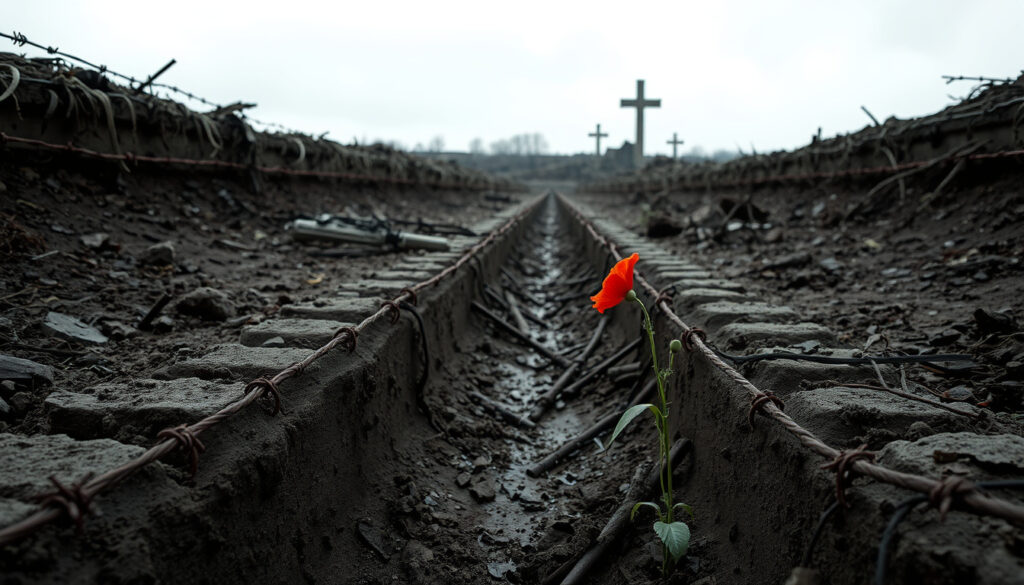
When Archduke Franz Ferdinand was shot on a Sarajevo street in June 1914, few could have guessed the killing would ignite a war that would consume Europe and reshape the world. Within weeks, a web of secret treaties and military plans turned a local crisis into a global conflict.
Start date: July 28, 1914 · End date: November 11, 1918 · Combatant deaths: approx. 9 million · Civilian deaths: approx. 7 million · Countries involved: Over 30 · Major alliances: Allies vs. Central Powers
Quick snapshot
- Assassination of Archduke Franz Ferdinand on June 28, 1914 (Encyclopaedia Britannica – leading reference work)
- Major alliances: Triple Entente and Triple Alliance (ANZAC Portal – Australian government educational resource)
- Armistice signed November 11, 1918 (National WWI Museum and Memorial)
- Debate over Germany’s primary war guilt (Article 231 vs. broader responsibility)
- Exact number of casualties (varies by source)
- Whether the war could have been avoided with different diplomatic actions
- June 28, 1914: Assassination of Franz Ferdinand
- July 28, 1914: Austria-Hungary declares war on Serbia
- April 1917: US enters the war
- November 11, 1918: Armistice ends fighting
- Treaty of Versailles imposes heavy reparations on Germany
- League of Nations established but fails to prevent future conflict
- Rise of extremism and economic hardship in defeated nations
Key facts at a glance
Six key dimensions show the scale and scope of the war, from its duration to the new technologies deployed.
| Dimension | Data |
|---|---|
| Duration | 4 years, 3 months, 2 weeks |
| Total military deaths | 8.5–9.5 million |
| Total civilian deaths | 6.5–7.5 million |
| Countries mobilized | Over 30 |
| New technologies used | Tanks, airplanes, poison gas, machine guns |
| Major treaties concluded | Treaty of Versailles (1919), Treaty of Saint-Germain (1919) |
What started WW1 and why?
The outbreak of World War I is best understood as a chain reaction: a single assassination triggered a cascade of mobilizations driven by long-standing rivalries and treaty obligations. The immediate cause was the murder of Archduke Franz Ferdinand, but deeper currents—militarism, alliance systems, imperial competition, and nationalism—had been building for decades (ANZAC Portal – Australian government educational resource).
The same alliance system designed to keep peace made escalation nearly automatic: when Austria-Hungary declared war on Serbia, Russia mobilized to defend Serbia, Germany mobilized to defend Austria-Hungary, and France was drawn in by its treaty with Russia.
“The war was a product of railway timetables and mobilization plans; once the trains started rolling, diplomats lost control.” – British historian A.J.P. Taylor
Why did Archduke Franz get assassinated?
- Gavrilo Princip, a Bosnian Serb nationalist, shot the Archduke in Sarajevo on June 28, 1914 (Encyclopaedia Britannica – leading reference work).
- Princip belonged to the Black Hand, a secret society seeking Serbian independence from Austria-Hungary.
- Serbian nationalism had been a major contributing force in the region (Norwich University Online – academic analysis).
- The assassination gave Austria-Hungary a rationale to crush Serbia, which it believed was supporting anti-Austrian activities.
The Archduke’s visit to Sarajevo was seen as a provocation by nationalists. Princip and his co-conspirators saw Habsburg rule as an occupation. The assassination itself was a chaotic affair—earlier that day a bomb had missed the Archduke’s car—but when the driver took a wrong turn, Princip found his target at close range.
The implication: The killing was not a premeditated act of war by a state, but its timing and target gave Austria-Hungary precisely the pretext it wanted to settle scores with Serbia.
Why did Germany have to start WW1?
- Germany offered Austria-Hungary unconditional support in July 1914, the so-called “blank check” assurance (Norwich University Online – academic analysis).
- German military planners believed that a war with Russia was inevitable and better fought sooner than later, given Russia’s rapid industrialization and railway expansion.
- The Schlieffen Plan required Germany to attack France first (through neutral Belgium) before turning to Russia, making the decision to mobilize a de facto decision for war on two fronts.
- German Chancellor Theobald von Bethmann-Hollweg later remarked on the “blank check” (BBC History – editorial overview).
“We are ready to stand by you, whatever happens.” – German Chancellor Theobald von Bethmann-Hollweg to Austria-Hungary, July 1914
Why “Germany had to start WW1” is a simplification. Germany’s leadership did not fire the first shot (Austria-Hungary declared war on Serbia first), but Germany’s choices—the blank check, the invasion of Belgium, and the refusal to attend a European conference—made a continental war nearly inevitable. The British-German naval arms race had already created deep mistrust (ANZAC Portal – Australian government educational resource).
Who was fighting in WW1 and why?
The war split Europe into two armed camps. On one side stood the Allies (the Triple Entente plus later joiners); on the other, the Central Powers. The reasons each nation joined were a mix of treaty loyalty, colonial ambition, and fear of being left isolated.
Who was the main bad guy in World War I?
- There is no single “bad guy.” The Treaty of Versailles assigned guilt to Germany (Article 231), but historians see shared responsibility among all major powers (Encyclopaedia Britannica – leading reference work).
- Germany’s invasion of neutral Belgium outraged public opinion and framed it as the aggressor in the West.
- Austria-Hungary’s harsh ultimatum to Serbia triggered the crisis.
- Russia’s early mobilization alarmed Germany and accelerated its war plan.
The idea of a “main bad guy” reflects wartime propaganda more than historical nuance. Each power pursued its own security interests, but those interests clashed explosively because no one was willing to back down.
Who was World War I fought against?
- Allies (Entente): France, United Kingdom, Russia (until 1917), Italy (from 1915), United States (from 1917) (National WWI Museum and Memorial; National Army Museum – UK military museum).
- Central Powers: Germany, Austria-Hungary, Ottoman Empire (from November 1914), Bulgaria (Wikipedia – general reference).
- Japan declared war on Germany in August 1914 and joined the Allies (National WWI Museum and Memorial).
Italy originally was part of the Triple Alliance with Germany and Austria-Hungary but switched sides in 1915 after secret negotiations with the Allies (National Army Museum – UK military museum). The Ottoman Empire’s entry opened fronts in the Middle East, including the disastrous Gallipoli campaign.
Who won the First World War?
The Allies won. The Central Powers collapsed in the autumn of 1918: Bulgaria signed an armistice in September, the Ottoman Empire in October, Austria-Hungary in early November, and Germany on November 11, 1918 (National WWI Museum and Memorial).
- German military leaders admitted defeat and sought an armistice, while civilian unrest and the Kiel mutiny forced the Kaiser to abdicate.
- The Treaty of Versailles (1919) officially ended the war, imposing harsh terms on Germany: territorial losses, military restrictions, and reparations of 132 billion gold marks (Encyclopaedia Britannica).
- President Woodrow Wilson’s Fourteen Points aimed for a just peace but were largely abandoned at the negotiating table.
“The world must be made safe for democracy.” – U.S. President Woodrow Wilson, 1917
The victors won the war but lost the peace: the punitive terms of Versailles sowed resentment in Germany that Adolf Hitler would later exploit, leading directly to World War II.
Why this matters: The “victory” was hollow for millions who died or were displaced, and the peace settlement created conditions for an even deadlier conflict two decades later.
Why did the Irishmen fight in WW1?
Ireland was part of the United Kingdom in 1914, so when Britain declared war, Ireland was automatically at war. About 200,000 Irishmen served in the British Army during the war, and roughly 30,000 died (BBC News – Irish WWI service overview).
- The Home Rule crisis (a bill granting self-government to Ireland had been passed but suspended) created a tense political context.
- Nationalist leader John Redmond urged Irishmen to join the British war effort, arguing that loyalty would be repaid with Home Rule after the war.
- Many volunteered out of economic need or a sense of duty; others opposed the war altogether.
- After the 1916 Easter Rising in Dublin, nationalist sentiment turned sharply against British rule, and conscription (never fully enforced) became deeply unpopular.
Irish soldiers fought in all major theaters, from Gallipoli to the Somme. The 16th (Irish) Division and the 36th (Ulster) Division suffered heavy losses. The war accelerated the push for Irish independence, and in 1922 the Irish Free State was established.
The catch: Irish participation in WWI is a story of divided loyalties—many fought for the British Empire, but the war ultimately helped break that empire’s hold on most of Ireland.
What was Hitler’s actual goal?
Adolf Hitler served as a soldier in World War I, was wounded twice, and was temporarily blinded by a gas attack in 1918. The war profoundly shaped his ideology (BBC History – editorial overview). He believed Germany had been “stabbed in the back” by internal enemies—socialists, Jews, and politicians who signed the armistice. This “stab-in-the-back” myth became a core element of Nazi propaganda.
- After the war, Hitler joined the German Workers’ Party and soon became its leader, with a goal to overturn the Treaty of Versailles.
- He aimed to expand German territory (Lebensraum) eastward, unify all German-speaking peoples, and establish a racially pure state.
- His 1923 Beer Hall Putsch failed, but he used his trial to gain national attention.
- Hitler’s WWI experience directly influenced his militarism and belief in a future war of revenge.
The implication: Hitler’s goal was not just to rebuild Germany but to destroy the Versailles order and create a new empire—goals that led directly to World War II.
When did World War 1 start and end?
The war began with Austria-Hungary’s declaration of war on Serbia on July 28, 1914, after the July Crisis. Fighting ended with the Armistice on November 11, 1918. Key milestones in between show how the conflict expanded and contracted.
- July 28, 1914: Austria-Hungary declares war on Serbia – start of the war.
- August 1914: Germany invades Belgium; Britain declares war; Western Front opens.
- 1915: Poison gas first used; Italy joins Allies.
- April 1917: United States declares war on Germany.
- March 1918: Russia signs Treaty of Brest-Litovsk, exits war.
- November 11, 1918: Armistice ends fighting (National WWI Museum and Memorial).
The pattern: The timeline shows how a regional crisis spiraled into global war, then ended with the collapse of empires and the redrawing of borders.
Frequently Asked Questions
How many soldiers died in World War I?
Total military deaths are estimated between 8.5 and 9.5 million. Civilian deaths add another 6.5–7.5 million (Encyclopaedia Britannica).
What countries were neutral in WW1?
Neutral countries included Switzerland, Spain, the Netherlands, Denmark, Sweden, and Norway. Some later joined the war or faced pressure.
What role did the Ottoman Empire play in WW1?
The Ottoman Empire joined the Central Powers in November 1914, opening fronts in the Middle East, including the Gallipoli campaign and the Arab Revolt.
How did WW1 lead to World War 2?
The harsh terms of the Treaty of Versailles, economic depression, and the rise of extremist parties like the Nazis exploited German resentment, leading to World War II.
What was the Christmas Truce of 1914?
In December 1914, soldiers on the Western Front unofficially ceased fighting, exchanged gifts, and played football. It was not repeated due to high command opposition.
How did the US help the Allies before entering the war?
The US provided loans, munitions, and supplies to the Allies. German submarine attacks on US ships eventually pushed the US to declare war in 1917.
What was the Zimmermann Telegram?
A 1917 German diplomatic proposal to Mexico to join the war against the US. Its interception and publication helped push the US into declaring war on Germany.
Related stories



Liam O'Brien covers Australian politics and public affairs for Aussie Report.