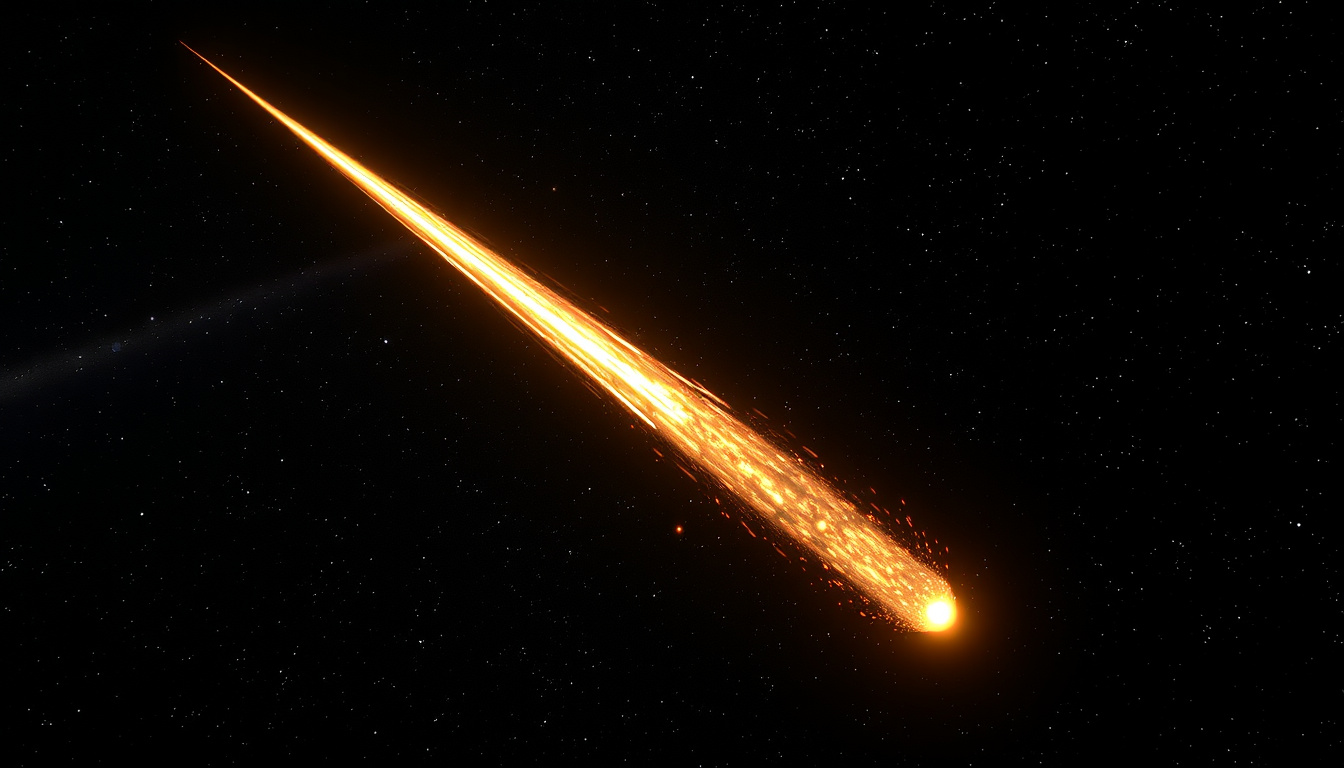

When astronomers spotted a faint, fast-moving object cruising through the inner solar system last summer, internet forums erupted with speculation—was it another ‘Oumuamua, an alien probe, perhaps something stranger? The truth turned out to be more fascinating than fiction: NASA’s entire fleet of heliophysics spacecraft, from the Sun-watching PUNCH mission to the deep-space Hubble and JWST, trained their instruments on Comet 3I/ATLAS, making it the most closely watched interstellar visitor ever. This is what the data actually shows, and why scientists say there’s no reason to panic.
Discovered: July 1, 2025 · Designation: C/2025 N1 (ATLAS) · Orbit Type: Hyperbolic (interstellar) · Detected By: NASA-funded ATLAS in Chile · Third Known: Interstellar object (after 1I/’Oumuamua and 2I/Borisov)
Quick snapshot
- Third confirmed interstellar comet (NASA Science)
- Hyperbolic trajectory confirmed (NASA Science)
- No Earth impact risk (NASA Science)
- Exact extrasolar origin region details pending
- Precise composition from MAVEN UV data pending
- Full size range from global astronomers (440m to 5.6km)
- Perihelion October 30, 2025 at 1.4 AU (NASA Science Open Science)
- 12 NASA assets coordinated observations (NASA Science Open Science)
- Post-departure data archives public (NASA Science Open Science)
- Continued ground telescope visibility
- Open NASA data for ongoing research
- Future interstellar visitors expected
A summary table consolidates key parameters for quick reference during observation campaigns.
| Parameter | Value |
|---|---|
| Official Name | C/2025 N1 (ATLAS) |
| Discovery Date | July 1, 2025 |
| Interstellar Status | Hyperbolic orbit confirmed |
| Primary Observer | NASA ATLAS in Chile |
| Earth Impact Risk | None detected |
What does NASA say about the 3I ATLAS?
Discovery details
The NASA-funded ATLAS telescope at Rio Hurtado, Chile, first identified the comet on July 1, 2025, though pre-discovery observations date back to June 14, 2025 (NASA telescopes and Caltech’s Zwicky Transient Facility collected over 100 pre-discovery measurements by July 3, 2025) (NASA Science). NASA’s TESS actually captured the comet two months earlier, in May 2025—the earliest detection—with that data publicly archived in the MAST repository (NASA Science Open Science). By early July, the object was already inside Jupiter’s orbit, roughly 420 million miles (4.5 AU) from the Sun (NASA Science Blog).
Orbit classification
NASA scientists classify 3I/ATLAS as an interstellar object because its hyperbolic trajectory means it moves too fast to be captured by the Sun’s gravity—it will exit the solar system rather than loop back (NASA Science). The comet reached perihelion (closest approach to the Sun) around October 30, 2025, at 1.4 AU (210 million km), just inside Mars’ orbit (NASA Science). Its initial speed at discovery was 137,000 mph (61 km/s) (NASA Science Facts and FAQs). At closest approach to Earth, the comet will be 1.8 AU away—about 270 million km (170 million miles)—and poses no threat (NASA Science).
NASA observations
NASA coordinated observations from 12 separate assets, an unprecedented solar system-wide campaign (NASA Science Multiple Lenses). The Mars Reconnaissance Orbiter captured the closest images from 19 million miles away; MAVEN provided UV data for composition analysis; and Perseverance even caught a glimpse from the Martian surface (NASA Science Multiple Lenses). Hubble observed on July and August 20, 2025, estimating the nucleus at 440 meters to 5.6 km in diameter (NASA Science Multiple Lenses). James Webb Space Telescope and SPHEREx captured imagery in August; STEREO observed September 11 to October 2; SOHO (an ESA/NASA mission) observed October 15-16 near the Sun; and the PUNCH mission imaged the comet’s tail September 20 to October 3—the first purposeful heliophysics observation of an interstellar object (NASA Science Multiple Lenses). Lucy spacecraft imaged the comet from 240 million miles on September 16, showing its coma and tail; Psyche observed from 33 million miles September 8-9, refining the trajectory (NASA Science Multiple Lenses). Hubble captured additional imagery November 30 via Wide Field Camera 3, and TESS imaged again in January 2026 (NASA Science Data Archives).
What happens if the 3I ATLAS hits Earth?
Impact scenarios
NASA and ESA both confirm there is zero collision risk—trajectory analysis with Mars observation data has pinpointed the path precisely (NASA Science, ESA). The comet’s closest approach to Earth will be 1.8 AU (about 270 million km), well beyond any realistic impact threshold. YouTube simulations of collisions with objects of this size circulate online, but they represent hypothetical scenarios that do not apply to 3I/ATLAS’s actual trajectory.
Size and effects
The nucleus diameter estimates range from 440 meters to 5.6 km (NASA Science Facts and FAQs). For context: an object in this size range could cause regional to continental-scale devastation if it struck Earth, but that is purely academic—3I/ATLAS will not come close enough to our planet to pose any physical threat.
Are we in danger from the 3I ATLAS?
Trajectory analysis
ESA’s planetary defense team used Mars observation data to refine the path, confirming no collision course (ESA via NASA Science Blog). The trajectory is known “fairly well,” according to NASA scientists—we know it came from outside the solar system (NASA YouTube). The direction of origin is the Sagittarius constellation, suggesting a journey from a cold, lonely region of the Milky Way (NASA Science Blog).
ESA FAQ insights
ESA’s planetary defense FAQ confirms that 3I/ATLAS poses no threat to Earth. NASA’s 12-asset observation campaign was designed for science, not planetary defense in the traditional sense—but the outcome is the same: a precise tracking record confirms a safe passage.
Why do people think that the 3I ATLAS is a spaceship?
Alien theories
Social media and YouTube discussions have speculated whether 3I/ATLAS could be an artificial probe—echoing the 2017 debate around 1I/’Oumuamua, which displayed unusual non-gravitational acceleration that remains debated to this day (NSF via YouTube). However, 3I/ATLAS displays a classic comet coma and tail, confirming it as a natural icy body releasing gas as it approaches the Sun (NASA YouTube). The comet is active: Hubble imagery shows a distinct coma around the nucleus, characteristic of sublimating ice—not an artificial structure.
Comparisons to Oumuamua
1I/’Oumuamua, discovered in 2017, was the first confirmed interstellar object and generated significant speculation due to its unusual cigar-like shape and non-gaseous nature. 2I/Borisov, discovered in 2019, was the first confirmed interstellar comet. 3I/ATLAS differs from both: it is the third interstellar object, the second confirmed interstellar comet (after Borisov), and has been observed by more NASA assets than any prior visitor (NASA Science). The additional observations have allowed astronomers to confirm it as a natural comet rather than the puzzling object ‘Oumuamua appeared to be.
The coma and tail visible in Hubble imagery confirm 3I/ATLAS as a natural comet behaving exactly as expected for an icy body visiting from another star system—no artificial probe characteristics have been identified.
Should Earth be worried about the 3I ATLAS?
Risk factors
There are none. Both ESA and NASA have confirmed no impact risk. The planetary defense community tracks objects like this precisely because early detection matters—and in this case, the news is good: 3I/ATLAS will safely pass, providing unprecedented science instead.
Monitoring updates
NASA has released tracker data and images on its dedicated pages (NASA Science, NASA Image Gallery). The comet was visible to ground telescopes through September 2025 and reappeared in early December 2025 after its close Sun passage. Hubble and TESS continue periodic imaging, and all data archives remain publicly available for ongoing research (NASA Science Data Archives).
Tracking and Observing 3I/ATLAS
Four data points anchor the timeline: NASA’s TESS first captured the comet in October 2025 (earliest detection); pre-discovery observations began June 14, 2025; the ATLAS telescope officially discovered it July 1, 2025; and Hubble made its size-estimate observation August 20, 2025 (NASA Science, NASA Science Data Archives). The comet reached perihelion October 30, 2025, at 1.4 AU from the Sun, with Hubble imaging again November 30 via Wide Field Camera 3 (NASA Science, NASA Science Data Archives). NASA describes this campaign as “unprecedented” and confirms it is the first time NASA’s heliophysics missions have purposefully observed an object originating in another solar system (NASA Science Multiple Lenses).
With 3I/ATLAS, scientists have an opportunity they may not get again for years: a confirmed interstellar comet that is active, observable by multiple spacecraft, and on a safe trajectory. The data gathered will inform how we understand the chemistry and dynamics of material from other star systems.
What We Know vs. What We Don’t
Confirmed facts
- Interstellar origin via hyperbolic orbit (NASA Science)
- Safe Earth trajectory at 1.8 AU (NASA Science)
- Natural comet with active coma (NASA YouTube)
- Third interstellar object after ‘Oumuamua and Borisov (NASA Science)
- Observed by 12 NASA assets (NASA Science Multiple Lenses)
- Nucleus size estimate 440m to 5.6km (NASA Science Facts and FAQs)
What’s unclear
- Exact extrasolar origin region—precise stellar neighborhood unknown
- Precise size and composition details pending full analysis
- Post-December 2025 observation updates awaited
- Possible ‘sister’ comet C/2025 V1 unconfirmed (YouTube tier-3 source)
- Composition data from MAVEN UV spectroscopy pending
NASA is in the midst of an unprecedented solar system-wide observation campaign, turning its spacecraft and space telescopes to follow comet 3I/ATLAS.
NASA Science (Official NASA publication)
This is the first time NASA’s heliophysics missions have purposefully observed an object originating in another solar system.
NASA Science (Official NASA publication)
We know its trajectory fairly well. We know it came from outside the solar system.
NASA representative via NASA YouTube official video
The scientific community’s verdict is unambiguous: 3I/ATLAS is a natural comet from interstellar space, confirmed by its hyperbolic trajectory and active coma. The alien spaceship speculation, while entertaining, does not hold up against the evidence. What is remarkable is not the fantasy—but the reality: an icy visitor from another star system, tracked by a dozen NASA spacecraft, with data archives that will fuel research for years. For planetary scientists, the choice is clear: keep watching, keep analyzing, and prepare for the next interstellar traveler.
Related reading: NASA’s multi-mission observations of Comet 3I/ATLAS · Comet 3I/ATLAS facts, trajectory and FAQs
science.nasa.gov, science.nasa.gov, youtube.com, kuow.org, science.nasa.gov
NASA’s latest images and data on 3I/ATLAS trajectory and facts further confirm its safe hyperbolic path through our solar system.
Frequently asked questions
Where can I track the 3I/ATLAS comet?
NASA publishes official tracking data and images on its dedicated 3I/ATLAS pages at science.nasa.gov. The comet’s trajectory is confirmed safe, with regular updates as observations continue.
What are the latest NASA images of 3I/ATLAS?
NASA’s image gallery shows observations from Hubble, JWST, STEREO, SOHO, PUNCH, Lucy, Psyche, and Mars-based assets including MRO and Perseverance. Images span July through November 2025, with Hubble’s Wide Field Camera 3 capturing the comet November 30.
When will 3I/ATLAS pass Earth?
Closest approach to Earth occurred around late 2025 at 1.8 AU (270 million km)—roughly four times the Earth-Sun distance. There is no risk of impact.
Is 3I/ATLAS similar to Oumuamua?
Both are interstellar objects, but 3I/ATLAS is a confirmed comet with visible coma and tail, while ‘Oumuamua’s non-gaseous nature made it harder to classify. 3I/ATLAS is also the third interstellar object and second interstellar comet.
What NASA video covers 3I/ATLAS?
NASA’s official YouTube channel released a video on the discovery and early observations, confirming the comet’s active nature with coma around the nucleus. The PUNCH mission also released tail imagery captured September 20 to October 3, 2025.
How fast is the interstellar comet 3I/ATLAS?
Initial speed at discovery was 137,000 mph (61 km/s). This hyperbolic velocity is what confirms its interstellar origin—it moves too fast to be bound by the Sun’s gravity.
What is the current update on 3I/ATLAS?
As of early 2026, TESS continues periodic imaging, and all observation data remains publicly available in NASA archives. The comet is outbound on its hyperbolic trajectory, having passed perihelion October 30, 2025, and will eventually leave the solar system.

Rachel Walsh leads fact-checking, source verification and corrections at Aussie Report.